Whether you're just starting your boxing journey or training regularly for combat sports, choosing the right punch bag can make a significant difference to your technique, power development and overall training experience. While gloves often get the attention, the size and weight of your punch bag are just as important.
A bag that's too light will swing excessively, making it difficult to develop proper technique. A bag that's too heavy for your experience level can increase the risk of poor form and unnecessary strain on your hands and wrists. A widely accepted guideline is to choose a hanging heavy bag that weighs approximately 40–50% of your body weight, although your training goals should also influence your decision
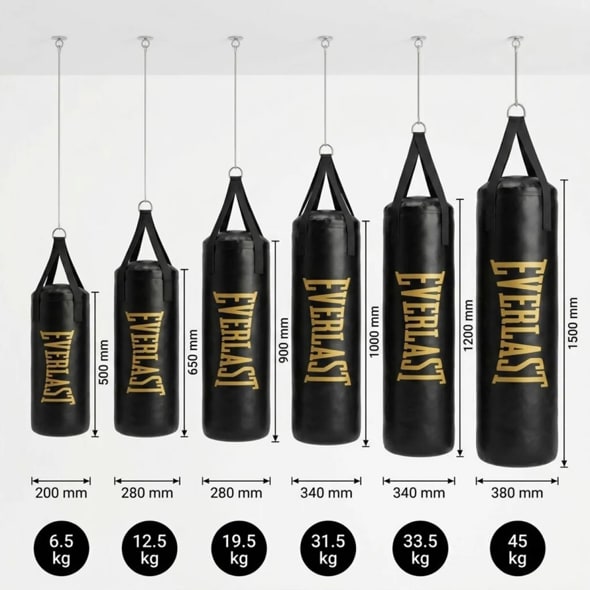
500 mm (6.5 kg)
Best for: Young children, beginners and light fitness workouts.
This compact bag is designed for light striking practice rather than power training. Its lighter weight allows younger users to learn correct punching mechanics while reducing impact forces. It is also suitable for basic cardio boxing workouts where power is not the primary focus.
Ideal for:
- Junior boxers
- Light fitness training
- Learning basic punches
- Coordination and hand-eye training
650 mm (12.5 kg)
Best for: Older children, teenagers and beginner adults.
Offering slightly more resistance, this size is suitable for developing basic combinations and improving cardiovascular fitness. It remains light enough to move considerably when struck, encouraging movement and timing.
Ideal for:
- Beginner boxing classes
- Home fitness
- Technique development
- Speed combinations
900 mm (19.5 kg)
Best for: Adult beginners and general fitness boxing.
This is often the first "full-size" punch bag suitable for adults. It provides a larger striking surface while remaining manageable for those learning proper technique. It can be used for straight punches, hooks and uppercuts but is still relatively light for heavy power work.
Ideal for:
- Fitness boxing
- Beginner combat sports
- General conditioning
- Combination drills
1000 mm (31.5 kg)
Best for: Intermediate boxers and kickboxers.
At over 30 kg, this bag provides noticeably greater resistance and swings less after impact. It allows users to develop punching power while still offering enough movement to practise timing and footwork.
Ideal for:
- Regular boxing training
- Kickboxing
- Strength and conditioning
- Power development
1200 mm (33.5 kg)
Best for: Boxing, kickboxing and Muay Thai.
The additional length makes this bag more versatile, allowing practitioners to train both punches and lower-body strikes. The heavier weight also provides improved stability during powerful combinations.
Ideal for:
- Boxing
- Kickboxing
- Muay Thai
- Knee strikes
- Low and mid-level kicks
Longer bags are generally preferred for sports involving kicks because they provide a larger target area for striking different heights
1500 mm (45 kg)
Best for: Advanced athletes and serious combat sports training.
This is a full-length heavy bag suitable for experienced users generating significant punching and kicking power. The increased weight reduces excessive swinging, allowing continuous combinations while closely simulating resistance experienced during combat training.
Ideal for:
- Advanced boxing
- Muay Thai
- MMA
- Heavy power training
- Full-body striking combinations
Heavier bags provide greater resistance, making them better suited for power development and reducing excessive movement during high-impact strikes.
Quick Guide:
|
Your Experience |
Recommended Bag |
|
Children |
6.5–12.5 kg |
|
Beginner adults |
19.5 kg |
|
Regular fitness boxing |
19.5–31.5 kg |
|
Intermediate boxing |
31.5–33.5 kg |
|
Kickboxing & Muay Thai |
33.5–45 kg |
|
Advanced power training |
45 kg |
The best punch bag isn't necessarily the biggest—it's the one that matches your experience, body size and training goals.
- Choose smaller, lighter bags for beginners, children and fitness-focused workouts.
- Choose medium-sized bags for developing boxing skills and conditioning.
- Choose longer, heavier bags for kickboxing, Muay Thai and advanced power training.
Speed Bag
Best for:
- Hand speed
- Timing and rhythm
- Hand-eye coordination
- Endurance
Unlike a heavy punch bag, a speed bag is not designed for power training. Instead, it rebounds quickly after each strike, helping improve punching speed, accuracy, rhythm and coordination. It's commonly used by boxers as part of their warm-up or technical training to develop faster hands and better reflexes.
Ideal for:
- Boxing
- Speed and reaction drills
- Improving coordination
- Building shoulder endurance
Tip: A speed bag is the perfect complement to a heavy bag. Use the heavy bag to develop power and technique, then switch to the speed bag to improve speed, timing and accuracy.